top of page

Anglican Parish of Bega
BEGA | TATHRA | BEMBOKA
Mustard Seed
THE MUSTARD SEED
MATTHEW 13:31-32
In 31 He told them another parable: “The kingdom of heaven is like a mustard seed, which a man took and planted in his field. 32 Though it is the smallest of all seeds, yet when it grows, it is the largest of garden plants and becomes a tree, so that the birds come and perch in its branches.”
The mustard seed is one of the most memorable illustrations Jesus used. Though it is tiny, it grows into a large plant. Jesus used this simple image to teach powerful truths about faith and the Kingdom of God.
In the parable of the mustard seed (Matthew 13:31-32, Mark 4:30-32, and Luke 13:18-19), Jesus said that the Kingdom of Heaven is like a mustard seed. What begins small and seemingly insignificant can grow into something great. God's kingdom often starts in ways we barely notice, yet its impact can be far-reaching and life-changing.
The parable also points us to Jesus Himself. He came into the world as a humble child born in Bethlehem. To many, He was just a carpenter from Nazareth, unnoticed and unimportant. Yet through His life, death on the cross, resurrection from the dead, and ascension into heaven, He changed the course of history and opened the way of salvation for all who believe. What appeared small and ordinary became the means by which God transformed the world.
Jesus also used the mustard seed to teach about faith. In Matthew 17:20, He told His disciples that faith as small as a mustard seed can move mountains. The focus is not on having a large amount of faith but on the greatness of the One in whom our faith is placed.
A small amount of faith in a great God is far more powerful than a great amount of faith in ourselves. Faith is about the source, not the size. The power is not in our faith; the power is in God. Even weak, struggling faith can accomplish great things when it is placed in Him.
Again, in Luke 17:6, Jesus used the mustard seed to remind His followers of the power of faith in daily life, including the challenge of forgiveness and obedience.
The mustard seed encourages us not to despise small beginnings. God can take our small acts of faith, our simple prayers, and our willing hearts and use them for His purposes. Just as a tiny seed grows into something far greater than anyone could imagine, God can do more through our lives than we could ever expect when we place our trust in Him.
May our prayer be the same as the apostles: "Lord, increase our faith."
Amen

"STAY CONNECTED TO ME"
JOHN 15:1-8
Jesus said: "I am the vine; you are the branches. If you remain in me and I in you, you will bear much fruit; apart from me you can do nothing." (John 15:5)
Today, most of us are constantly connected to our devices. We wake up and check our phones. We read messages, scroll through social media, check the news, and respond to emails. Many of us spend more time connected to our screens than we do connected to Jesus.
When our phone battery gets low, we immediately look for a charger. When we forget our phone at home, we often feel disconnected or anxious. Yet how often do we feel the same urgency when we neglect prayer, Bible reading, or time with God?
Jesus reminds us that our greatest connection is not to a device but to Him. Phones can connect us to information and people, but they cannot give us peace, purpose, wisdom, or eternal life. Only Jesus can do that.
The challenge for us today is not whether we are connected, but what we are connected to. If we spend more time plugged into the world than plugged into Christ, our spiritual lives will suffer. We may be informed, entertained, and busy, yet still feel empty and disconnected.
The good news is that Jesus invites us to remain in Him. He is always available, always present, and never out of reach. When we stay connected to Him through prayer, His Word, worship, and fellowship with other believers, we receive the strength and nourishment we need to live fruitful lives.
Eight times in eight verses, Jesus gives us one simple but powerful message: Remain in Me – stay plugged into Me. In a world that constantly demands our attention, there is great encouragement in knowing that when we stay connected to Christ, we are connected to the source of life, hope, strength, and peace that never runs out.

AS WE FORGIVE THOSE...
MATTHEW 6: 12-15
It was a sermon on forgiveness, not long after I had started going back to church following 20 years away, that became a real turning point for me. The message that day focused on two verses in the Lord’s Prayer. I had said that prayer more times than I could count, but on that day I realised something—I had never truly prayed it.
When Jesus’ disciples asked Him how to pray, He taught them what we now call the Lord’s Prayer:
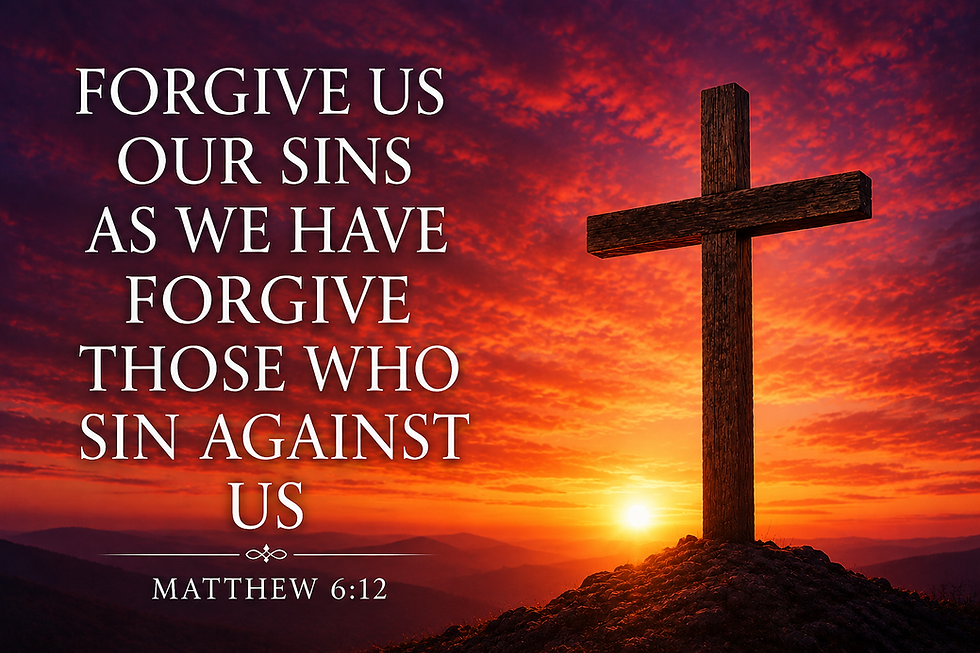
“Forgive us our sins, as we forgive those who sin against us.” (Matthew 6:12), but then 2 verses later He explained it: “For if you forgive other people when they sin against you, your heavenly Father will also forgive you. But if you do not forgive others their sins, your Father will not forgive your sins.” (Matthew 6:14–15)
The preacher said it simply and directly: “If you want God to forgive you, you have to forgive others—it’s not optional. If you don’t, He won’t.” He then paused, and after a little while added, “I could say “End of Sermon” … but I won’t.” But for me … he could have. I remember feeling sick as those words landed. I was suddenly aware of two things at once – my own sin before God—more than I could ever count – and the deep unforgiveness I had been carrying for years – on numerous fronts.
What struck me was this: Jesus doesn’t just say it in the prayer… He then explains it straight away. And forgiveness is the only part of the Lord’s Prayer He expands on like that. That day, I understood why.
Because forgiveness is central to everything. That’s why Jesus speaks so seriously about it again when Peter asks:
“Not seven times, but seventy times seven.” (Matthew 18:22). In other words—there is no limit. Forgiveness isn’t meant to run out.
This is a direct and sobering teaching. Jesus connects our receiving of forgiveness from God with our willingness to extend forgiveness to others. It isn’t a side issue. It sits at the heart of what it means to live in God’s kingdom. It’s why God sent Him, it’s why He came and it’s what He died for. Because God’s purpose in sending Jesus wasn’t only to forgive us… but to restore what sin has broken—between us and Him, and between us and one another.
Forgiveness, then, isn’t something we manufacture. It’s first received as a gift, and only then, by God’s grace, extended to others.
When we don’t forgive, it doesn’t stay contained. It spreads quietly. It replays the wound, hardens the heart, and keeps us tied to what has already happened. What begins as pain can slowly become bitterness, and bitterness can become distance in relationships.
Forgiveness is different. It doesn’t deny the hurt or pretend it did not matter. It doesn’t call wrong “right.” It’s the decision to lay it down. To stop replaying it. To stop holding it over someone. And to refuse to let it define the present or the future.
Forgiveness may not change the person who has wronged us, and it may not undo what has been done. But it does change us. It loosens the grip of what was done to us, so that it no longer has authority over our present. It breaks the cycle of replaying the wound, and slowly begins to reshape how we carry it.
Unforgiveness traps us in cycles of anger and replaying old wounds. But forgiveness begins to break that cycle. It creates space to live differently—more freely, more honestly, and with more peace. It allows us not only to be forgiven by God, but to live in that forgiveness in a way that reshapes how we see others and how we carry the past.
And it’s only possible through God and what He has done for us in Jesus Christ. The forgiveness we have received at the cross becomes the foundation for how we forgive others. That’s why forgiveness isn’t only obedience, but also freedom. It breaks the grip of bitterness, begins to heal what resentment keeps open, and protects relationships from being quietly eroded over time.
Jesus speaks of forgiveness as essential to living in God’s grace—and as the natural outworking of receiving it. Over time, it leads us into something deeper: peace with God, peace within ourselves, and a way of life shaped not by the past, but by His mercy.
bottom of page